

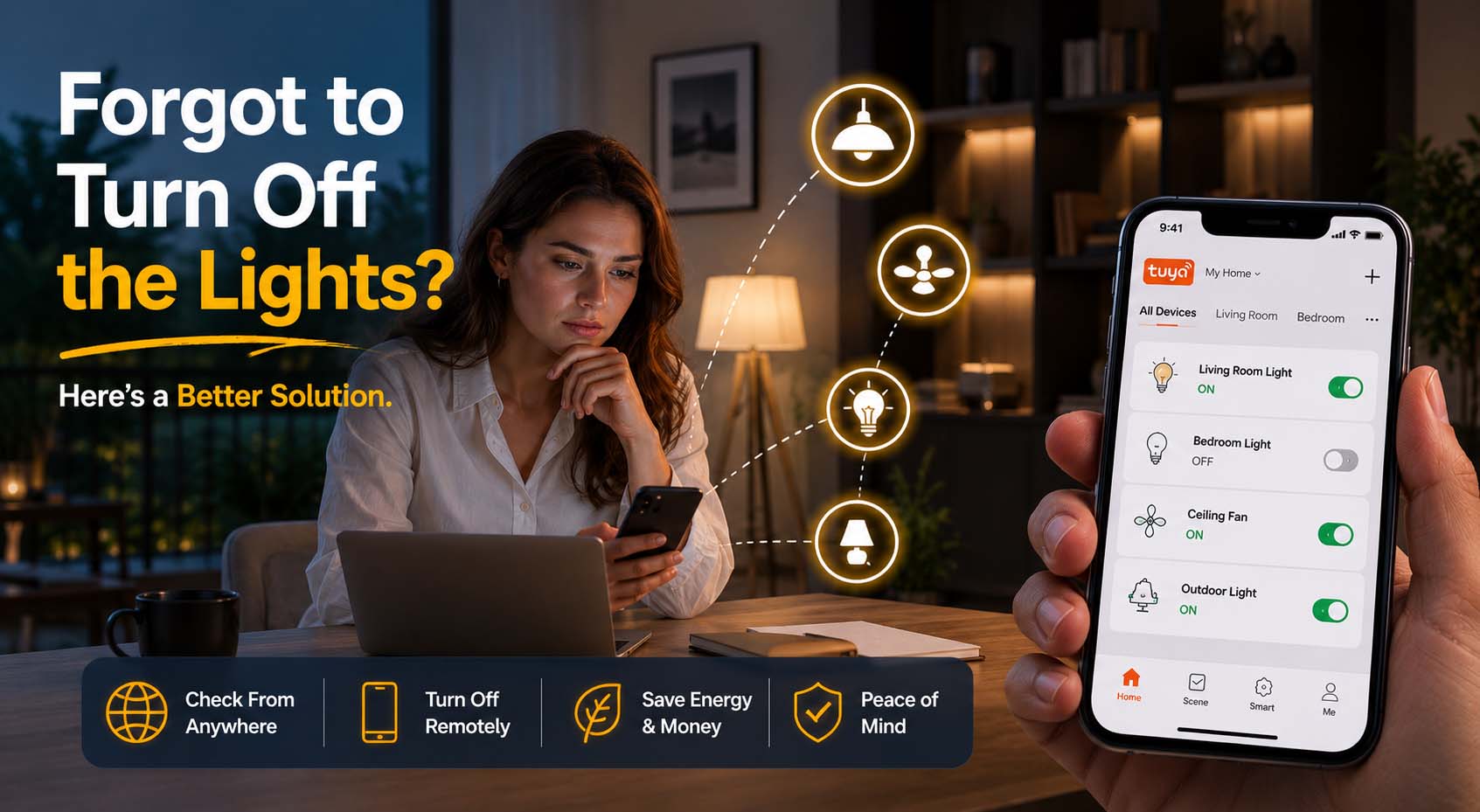

It Happens More Often Than You Think
You’re halfway to work when a familiar thought suddenly appears.
“Did I turn off the living room lights?”
You try to remember. You picture yourself leaving the house. You replay your morning routine. But you can’t be certain. Was it the living room light? The outdoor lights? The bedroom fan?
For many homeowners, this small moment of uncertainty happens regularly. Sometimes it’s not even the lights. It could be a fan, a water pump, an outdoor light, or another appliance that was left running during the rush of a busy morning.
The result is usually the same: a day filled with uncertainty, unnecessary stress, and sometimes a higher electricity bill.
While this may seem like a minor inconvenience, it highlights a much larger issue with the way we interact with our homes. Fortunately, modern home automation offers a surprisingly simple solution.
The Real Problem Isn’t the Light
Most people assume the issue is wasted electricity. While that is certainly a concern, the bigger problem is actually the lack of control. Once you leave your home, you lose visibility.
You don’t know what’s on. You don’t know what’s off. And unless someone is at home, there’s often no way to check.
This creates a common cycle:
- Leave home
- Remember something might have been left on
- Spend time worrying about it
- Promise yourself to be more careful next time
- Repeat the process again next week
The reality is that even the most organized people forget things. Modern life is busy, and our homes still rely heavily on manual actions that depend entirely on memory.
Why Traditional Switches Haven’t Changed in Decades
Think about it. We use smartphones to manage our finances. We order food through apps. We attend meetings from anywhere in the world. Yet many homes still rely on the exact same light switch technology used decades ago.
A traditional switch has one job: turn something on or off when you’re physically standing in front of it. The moment you leave the house, your control ends.
That limitation has simply become accepted as normal. But it doesn’t have to be.
A Smarter Way to Control Your Home
Imagine arriving at work and suddenly wondering whether you left the lights on. Instead of worrying, you open an app on your phone. Within seconds, you can see the status of your lights and switches.
If something is still on, you simply tap a button to turn it off. No guessing. No stress. No driving back home. No asking a neighbour to check.
This is one of the simplest benefits of a smart switch and one of the reasons why home automation is becoming increasingly popular among everyday homeowners.
What Exactly Is a Smart Switch?
A smart switch looks similar to a traditional wall switch but offers significantly more functionality.
In addition to manual operation, it allows you to control connected devices through your smartphone, automation schedules, and other smart home features.
This means you can:
- Turn lights on and off remotely
- Create schedules for daily routines
- Automate frequently repeated actions
- Monitor the status of connected devices
- Control your home even when you’re away
Importantly, the switch still functions normally from the wall. The technology simply adds a layer of convenience and control.
Small Problem, Big Impact
At first glance, forgetting to switch off a light may seem insignificant.
However, when you consider how often it happens over months and years, the impact becomes more noticeable.
Energy Waste
Lights and appliances running unnecessarily consume electricity that serves no purpose.
Daily Stress
The uncertainty of not knowing whether something was left on can become surprisingly frustrating.
Inconvenience
Returning home to check a switch is a waste of time that nobody enjoys.
Reduced Peace of Mind
Your home should provide comfort, not additional things to worry about.
A smart home solution addresses all of these challenges with a relatively small upgrade.
Going Beyond Individual Switches
One of the biggest advantages of home automation is that it doesn’t stop at controlling individual lights. As your system grows, you can create entire routines that match your lifestyle.
For example:
Leaving Home Mode
When you leave the house:
- All selected lights switch off
- Fans turn off automatically
- Outdoor lighting follows a schedule
- Certain appliances can be powered down
Instead of checking every room individually, one action handles everything.
Night Mode
Before bed:
- Living room lights switch off
- Bedroom lighting adjusts automatically
- Outdoor security lighting remains active
Again, convenience replaces repetition.
Home Automation Isn’t Just for Luxury Homes
One of the biggest misconceptions about smart homes is that they are only suitable for luxury villas or high-end properties.
This perception was understandable years ago when automation systems were expensive and complex. Today, things are very different. Modern smart home technology allows homeowners to start small and expand gradually.
You don’t need to automate your entire house. You don’t need major renovations. You don’t need a massive budget.
Many homeowners begin with a single smart switch in the room they use most often. From there, they add new features over time based on their needs and budget.
The Value of Peace of Mind
When people first explore home automation, they often focus on the technology itself. The apps. The switches. The features.
However, long-term users frequently describe a different benefit as the most valuable. Peace of mind. Knowing that you can check and control your home from anywhere removes a surprising amount of daily stress.
Instead of wondering whether you remembered everything before leaving, you know you can verify it instantly.
That confidence changes how you interact with your home.
The Future of Everyday Living
Home automation is often portrayed as futuristic technology. In reality, it’s becoming something much more practical. It’s not about showing off gadgets.
It’s not about turning your home into a science-fiction movie. It’s about solving everyday problems in a smarter way.
Problems like:
- Forgetting lights
- Wasting electricity
- Managing daily routines
- Maintaining control while away from home
These are challenges almost every homeowner experiences. And increasingly, smart home technology is becoming the simplest way to solve them.
Final Thoughts
The next time you’re halfway to work and wondering whether you left the lights on, ask yourself a simple question:
Why should something so small create so much uncertainty?
Technology has already simplified many aspects of modern life. Managing your home should be no different. The good news is that you don’t need a luxury villa or a large budget to get started.
Sometimes, a smarter home begins with a single switch. And that one small upgrade can make everyday living noticeably easier, more comfortable, and far more convenient.
Ready to Take the First Step?
Home automation doesn’t have to start with an entire smart home. It can start with solving one everyday problem. And for many homeowners, that journey begins with a single smart switch.