


Home Automation Is Everywhere, You Just Might Not Realize It Yet
A few years ago, the idea of controlling your home from a smartphone sounded futuristic. Today, many of us already interact with smart technology every day.
We unlock cars remotely, monitor security cameras from our phones, control air conditioners through apps, and receive notifications from connected devices.
Home automation takes this concept a step further by bringing these capabilities together into a connected living environment that is more convenient, efficient, and comfortable.
Yet despite its growing popularity, many homeowners still ask a simple question:
“What exactly is home automation?”
Let’s break it down.
What Is Home Automation?
Home automation is the ability to control and automate devices in your home using technology.
Instead of manually operating every light, fan, appliance, or system, you can control them remotely, schedule their operation, or automate them to respond to specific conditions. In simple terms, your home becomes capable of assisting with everyday tasks.
Examples include:
- Turning lights on and off from your phone
- Scheduling outdoor lights to operate automatically
- Controlling devices while away from home
- Creating routines for morning and nighttime activities
- Monitoring parts of your home remotely
- Automating repetitive daily actions
The goal is not to replace people. The goal is to reduce effort and improve convenience.
Home Automation Is About Lifestyle, Not Technology
One of the biggest misconceptions is that home automation is primarily about gadgets. In reality, it’s about solving everyday problems.
Consider a few common situations:
Leaving for Work
Instead of checking every room before leaving, one command can turn off selected lights and devices.
Coming Home at Night
Outdoor lights can automatically switch on before you arrive.
Going on Vacation
Your home can continue operating certain lights on schedules to create the appearance of occupancy.
Managing Daily Routines
Morning and evening routines can be simplified through automation. The technology exists in the background. The real benefit is the convenience it creates.
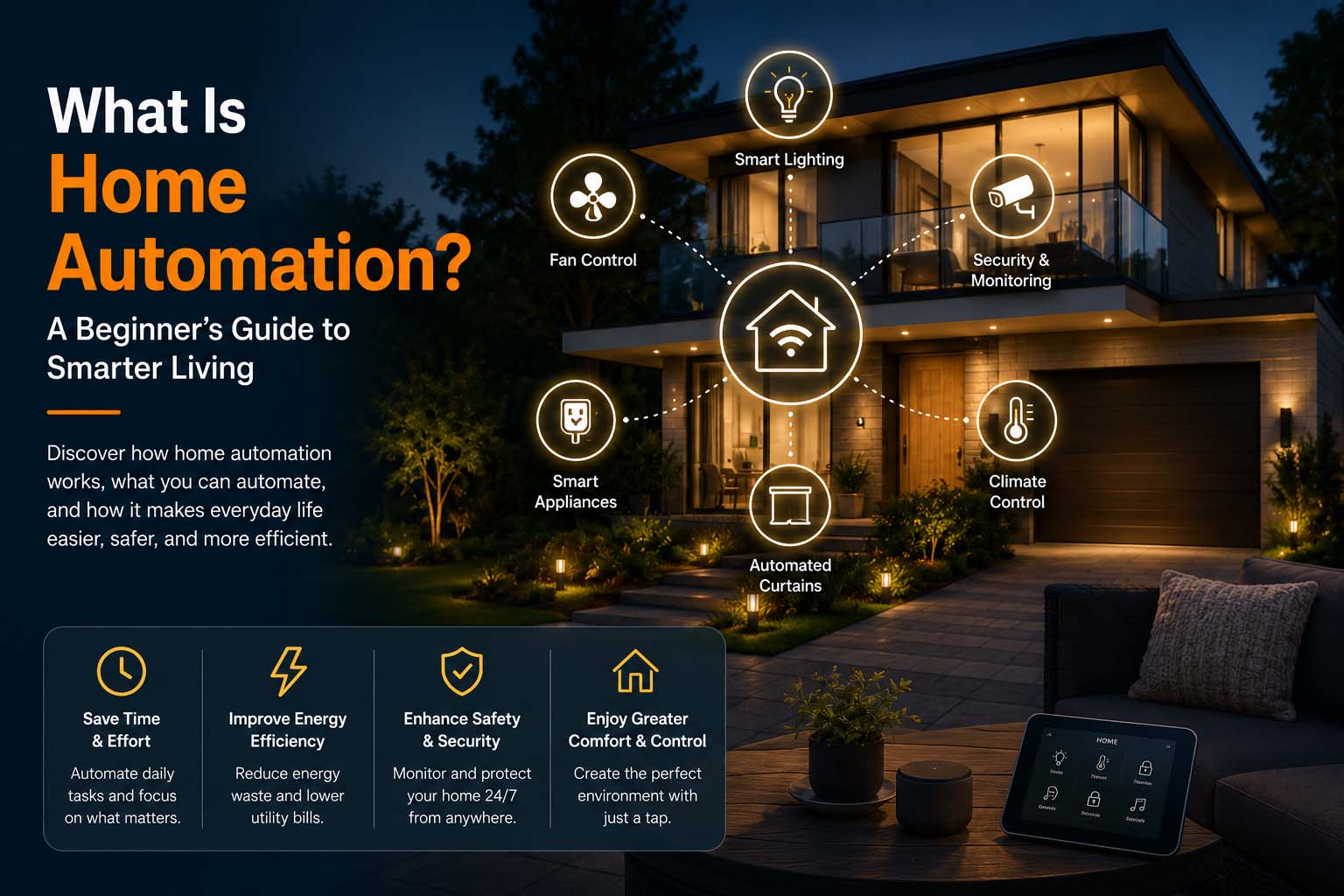
What Can Be Automated?
Modern home automation systems can manage a wide variety of devices.
Lighting
One of the most popular starting points for homeowners.
Benefits include:
- Remote control
- Scheduling
- Group control
- Scene creation
Fans
Control ceiling fans from your smartphone or automate them based on schedules.
Outdoor Lighting
Automatically operate garden and security lighting.
Appliances
Selected appliances can be controlled remotely depending on installation requirements.
Security Systems
Integrate monitoring and alerts into a single connected ecosystem.
Sensors
Smart sensors can detect movement, door activity, temperature changes, and other environmental conditions.
How Does Home Automation Actually Work?
At a basic level, a home automation system consists of three key components.
Devices
These include smart switches, sensors, controllers, and connected equipment.
Communication
Devices communicate using technologies such as:
- WiFi
- Zigbee
- Matter-compatible protocols
- Other wireless communication standards
Control Platform
A mobile app or central platform allows users to monitor and control the system.
When these components work together, your home can respond intelligently to commands, schedules, and events.
A Real-Life Example
Imagine you’re leaving home for work. Instead of manually checking every switch, you activate a “Leaving Home” scene.
Instantly:
- Living room lights switch off
- Bedroom lights switch off
- Outdoor lighting follows its schedule
- Selected devices enter energy-saving mode
One action replaces multiple repetitive tasks. This is the essence of automation.
Is Home Automation Only for Luxury Homes?
Absolutely not. This is perhaps the most outdated belief in the industry. Years ago, home automation systems were expensive, complex, and targeted primarily at luxury properties.
Today, modern technology has dramatically reduced the cost and complexity of implementation. Homeowners can now begin with a single smart switch and expand gradually over time.
You don’t need:
- A luxury villa
- A newly built house
- A complete renovation
- A massive budget
You simply need a starting point.
What Happens If the Internet Goes Down?
This is one of the most common questions homeowners ask. The answer depends on the system design. Many modern smart home solutions continue to function locally even if internet connectivity is unavailable.
For example:
- Physical wall switches continue operating normally
- Local automation functions may remain active
- Scheduled operations can continue depending on system architecture
The internet is often required for remote access from outside the home, but a well-designed automation system should not become unusable simply because the internet connection is interrupted.
This is why selecting the right platform and technology is important.
Is Home Automation Safe?
When implemented correctly, modern home automation systems are designed with security in mind.
Reputable platforms use:
- Encrypted communication
- Secure authentication methods
- Access controls
- Regular firmware updates
As with any connected technology, good security practices remain important.
This includes:
- Using strong passwords
- Keeping devices updated
- Choosing trusted products
- Protecting home network access
For most homeowners, modern smart home systems are no more risky than using online banking, social media, or cloud-based applications.
Can Smart Homes Be Hacked?
This question often appears in discussions about home automation. The honest answer is that any internet-connected technology carries some level of risk.
However, the same is true for:
- Smartphones
- Computers
- Security cameras
- Online banking platforms
- Email accounts
The important factor is not whether technology can theoretically be attacked.
The important factor is whether proper security measures are implemented.
When quality products, secure networks, and recommended security practices are used, smart home systems can provide a highly secure experience for homeowners.
Why Home Automation Is Becoming Mainstream
Every major technology follows a similar pattern. Initially, it appears expensive and exclusive. Then it becomes more affordable, more accessible, and eventually becomes a standard part of daily life.
We’ve already seen this happen with:
- Smartphones
- Broadband internet
- Streaming services
- Cloud storage
- Online banking
Home automation is following the same path. As technology becomes more affordable and user-friendly, connected living is becoming less of a luxury and more of an expectation.
The Future of the Modern Home
The purpose of home automation is not to fill your house with technology. The purpose is to create a living environment that works better for you.
A home that:
- Saves time
- Reduces effort
- Improves convenience
- Provides greater control
- Enhances comfort
Whether you start with a single smart switch or eventually build a fully connected home, the principle remains the same. Home automation is not about technology for the sake of technology. It’s about making everyday living simpler.
Final Thoughts
Home automation is often misunderstood as something complex, expensive, or reserved for luxury homes. The reality is much simpler.
It is the process of using technology to make your home more convenient, efficient, and responsive to your lifestyle.
You don’t need to automate everything. You don’t need a large budget. And you don’t need to be a technology expert.
The journey can begin with something as simple as a single smart switch. Because modern home automation isn’t about building a house of the future. It’s about making today’s home work better for the people living in it.